
Alec Brenner on When Tectonic Plates First Moved
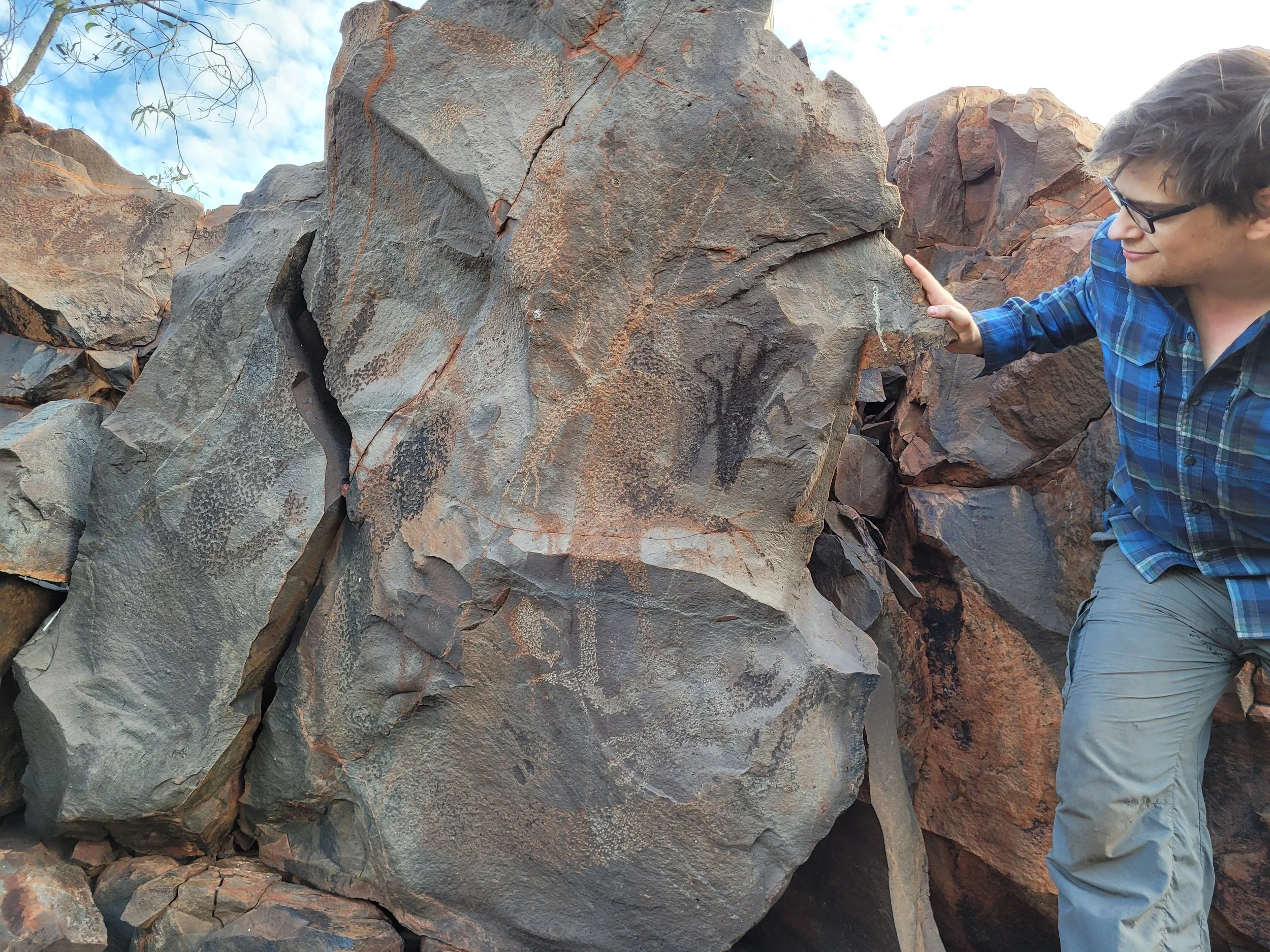
In the podcast, Alec Brenner describes how he used paleomagnetism to determine the latitude of rocks in the East Pilbara region of Western Australia. He found that the rocks changed their latitude from about 53° to about 77° over a span of several million years in the Paleoarchean (about 3.5 billion years ago). This rapid motion in the Pilbara contrasts with the apparent lack of motion of the Kaapvaal craton during the same period. Together, these finds show that plates were moving independently a billion years earlier than any previous such detection. The results do not imply modern-style plate tectonics was already occurring, but they do rule out a stagnant lid, like that on Mars or Venus. Brenner also explains that his results have a bearing on the state of Earth’s core and the atmosphere during the Paleoarchean.
The image shows Brenner with 3.47-billion-year-old pillow basalts in the East Pilbara. He is a Postdoctoral Associate in the Department of Earth & Planetary Science at Yale University.
Podcast Illustrations
Images courtesy of Alec Brenner unless otherwise noted.
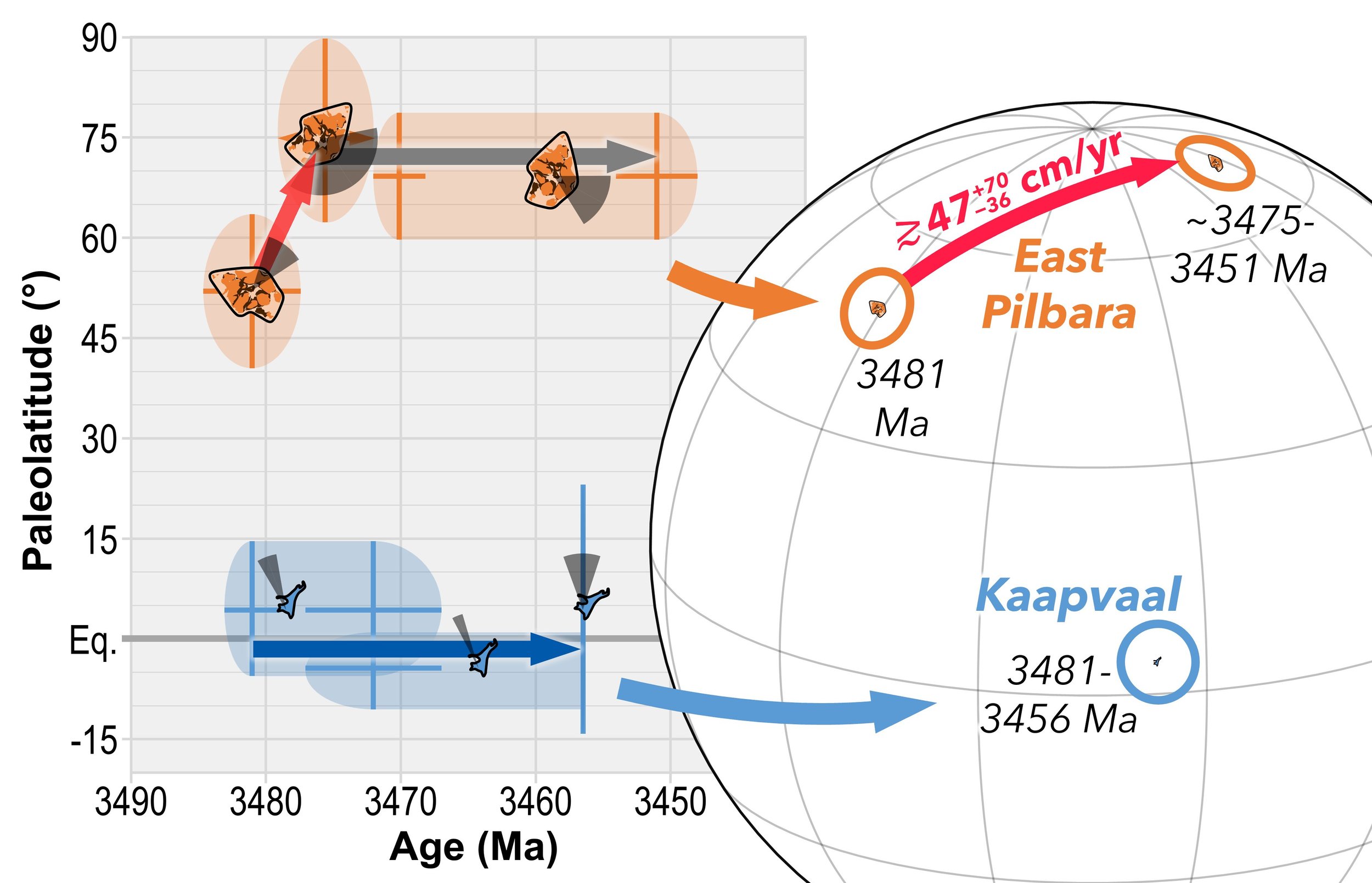
Brenner’s Results
The paleomagnetic studies showed that between 3,481 million years ago (Ma) and ~3,475-3,451 Ma, the East Pilbara craton moved from a latitude of 53°N to about 77°N at a rate of very roughly 47 cm/year. This is comparable to the fastest plate motions observed today. Over the same period, other workers have shown that the Kaapvaal craton in South Africa did not move in latitude. This is evidence that the two crustal blocks were moving independently of each other, with some kind of a boundary between them.
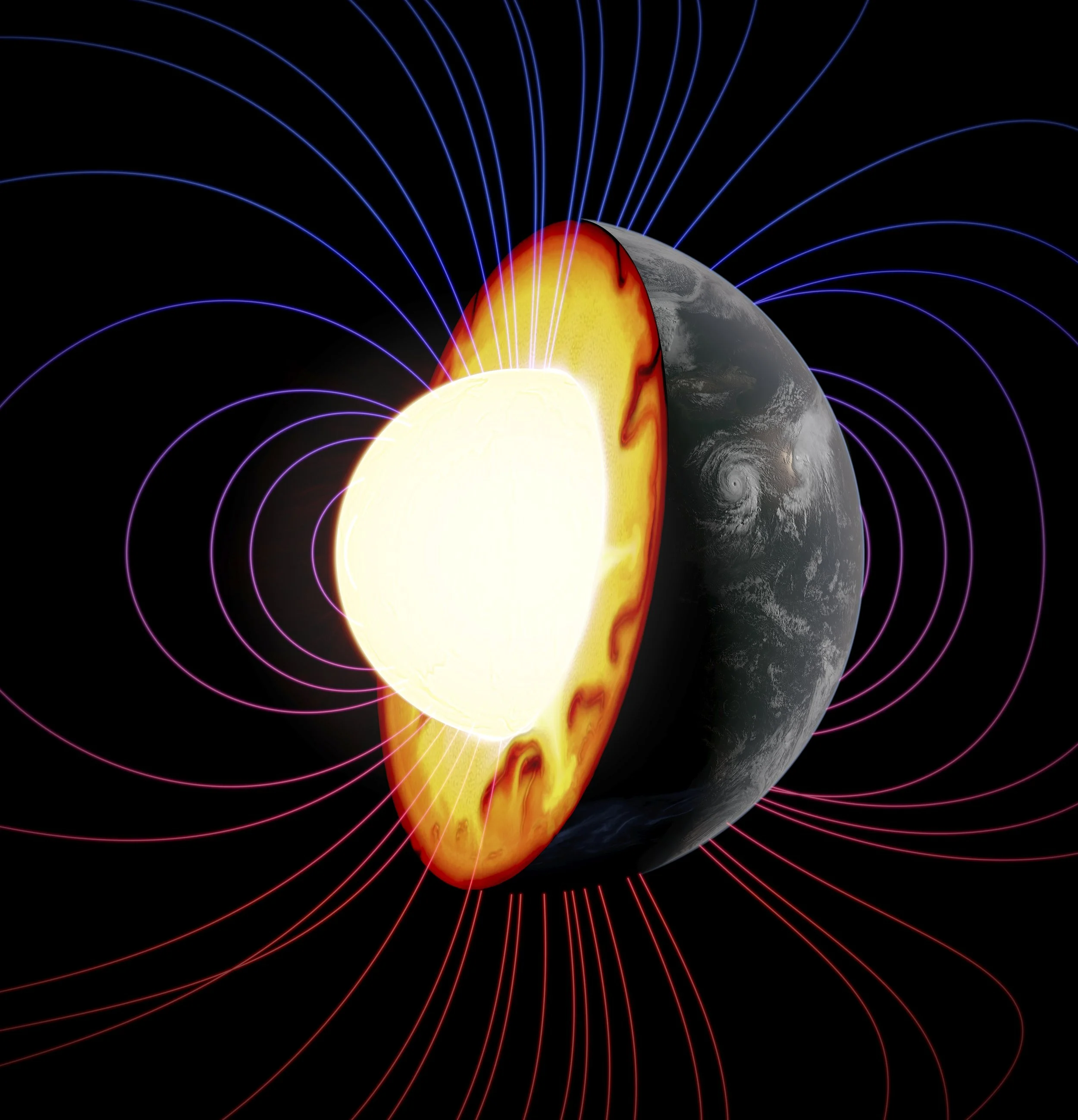
The Earth’s Magnetic Field
Diagrammatic cross-section of the Archean Earth showing local subduction of the lithosphere without a global system of plates. The magnetic field lines vary from horizontal at the equator to vertical at the poles, which is what enables the latitude of the rocks at the time of magnetic imprinting to be determined. Brenner’s measurements also detected a magnetic reversal of the kind we see occurring in the recent past, though his data suggests they were much less frequent in the Archean.
Field Work—Obtaining the Rock Samples
Brenner and his colleagues preparing to obtain samples in East Pilbara in Western Australia.
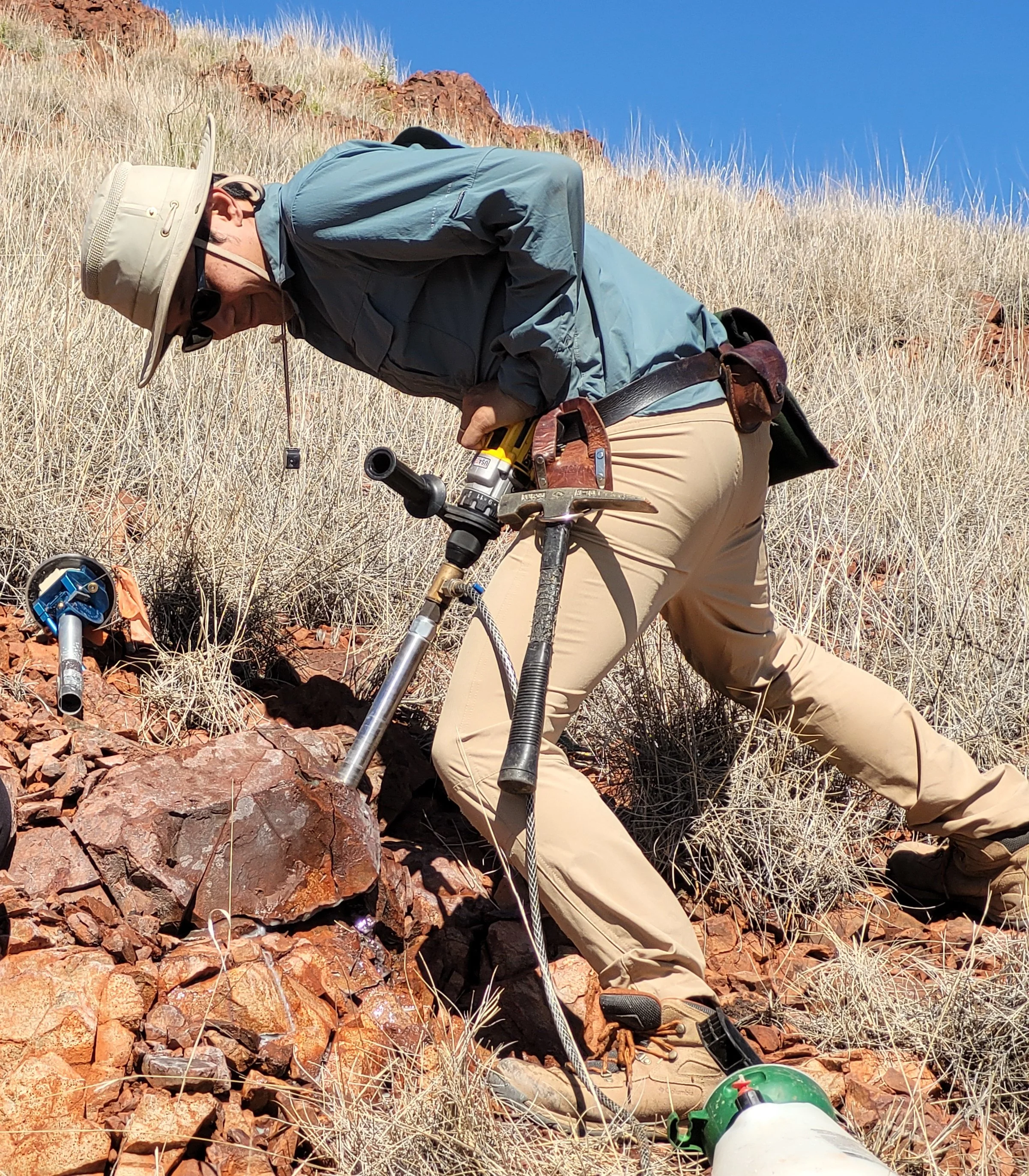
Roger Fu, Brenner’s PhD supervisor at Harvard University, drilling out one of the core samples used for Brenner’s study.
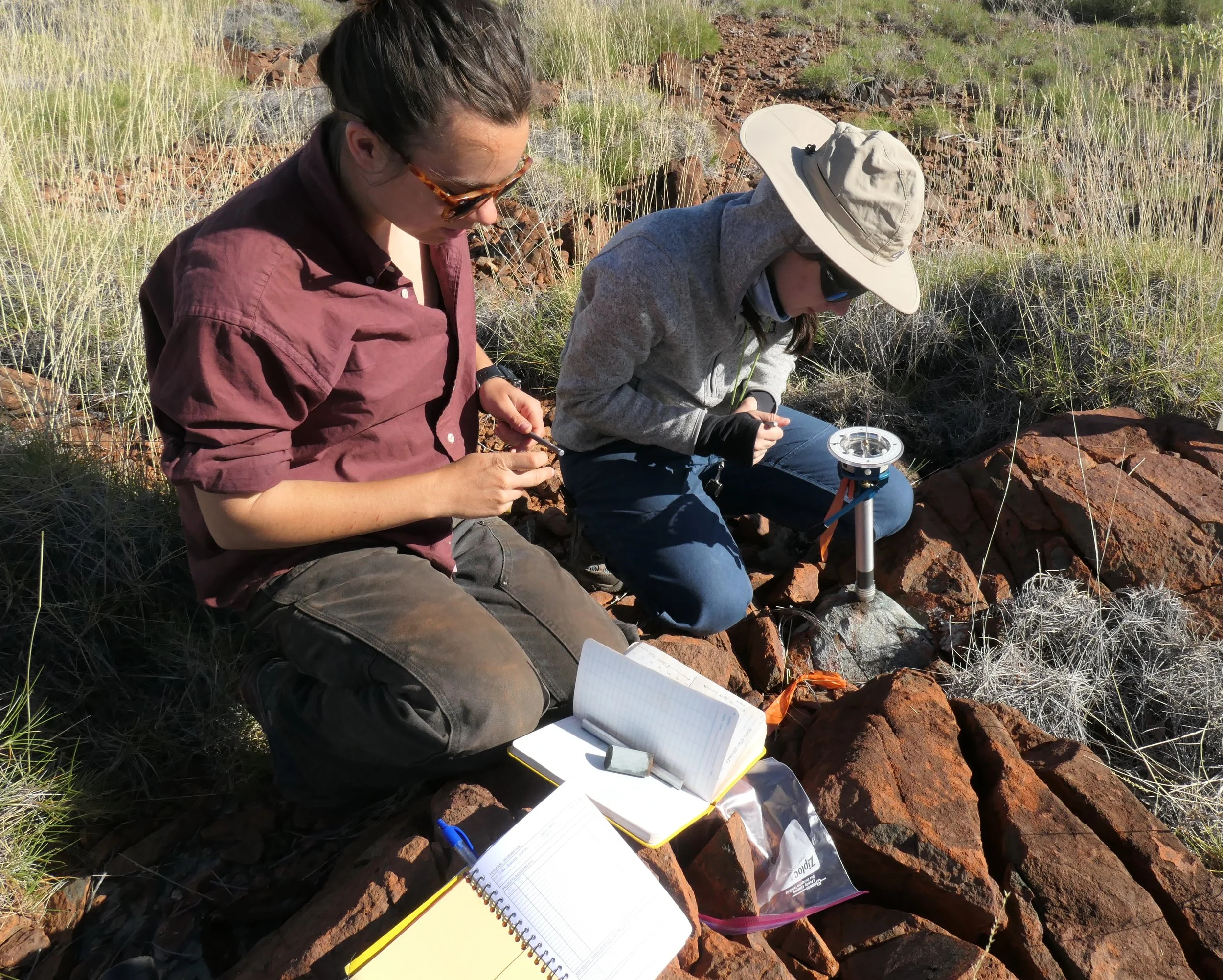
Sarah Steele and Öykü Mete orienting 3,481-million-year-old core samples. A crucial part of the paleomagnetic method is to record the in-situ orientation of the rock samples that are taken to the lab where their magnetic field direction is measured.
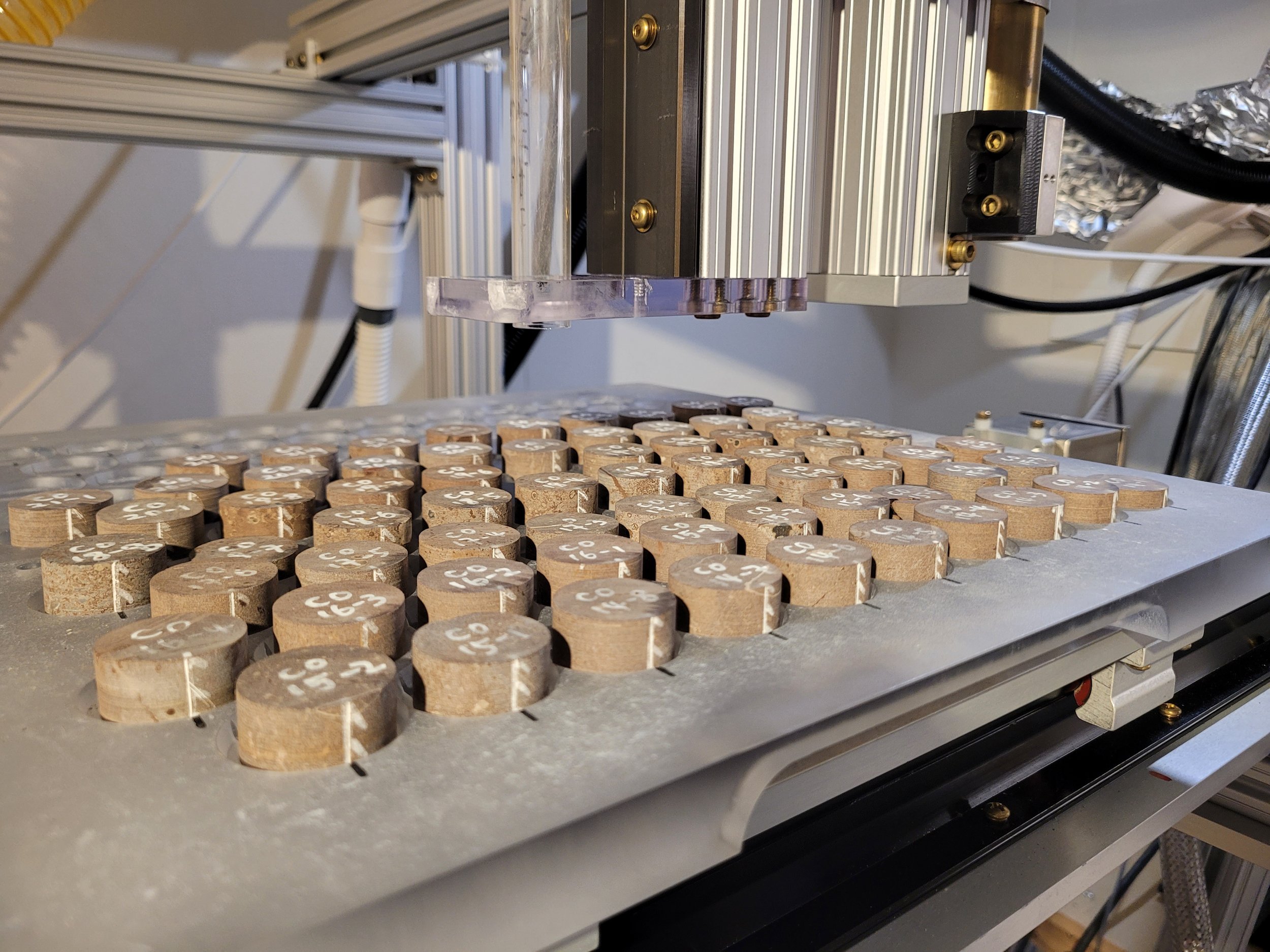
Core samples on the magnetometer tray in the paleomagnetism lab at Harvard where the magnetic field directions in the samples are determined.
Magnetization of the Sampled Seafloor Lavas
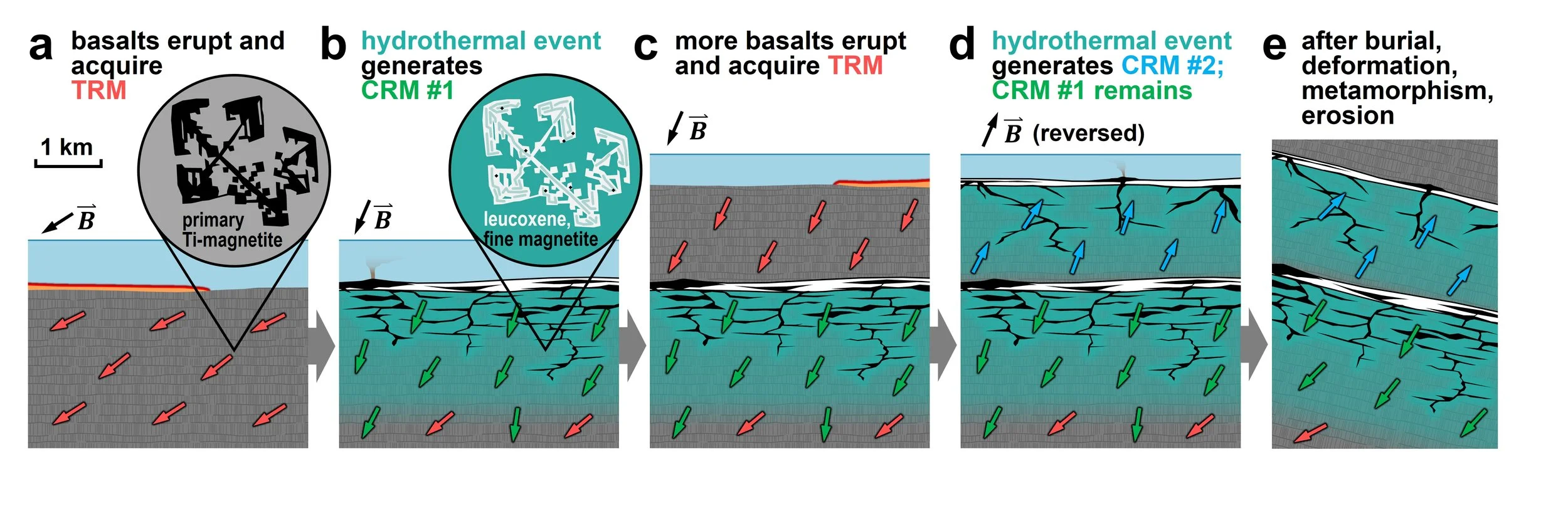
In the podcast, Brenner explains that the magnetic signal he measured in his samples was created by hydrothermal events occurring shortly (a few million years) after the lavas were extruded. The timing of these hydrothermal events can be bracketed quite accurately owing to the presence of layers of sedimentary rocks with zircons on either side of the lava flows. a: Original field is imprinted into basalts (red arrows), lost to us now. b: Shortly (a few Ma) after, a hydrothermal event resets the magnetic field (green arrows) accompanied by deposition of a thin layer of sedimentary rocks on top, some of which can be dated using U-Pb dating of zircons (white/black layer). c: Another basaltic eruption imprinted with the current field (red arrows) covers the sedimentary layer. d: Another hydrothermal event with another felsic sedimentary layer deposited on top resets the second basaltic lava flow (blue arrows), but the magnetic field in the first lava flow (green arrows) remains undisturbed. This is because its magnetite grains, which are mostly sensitive to pH, are buffered to equilibrium in the host rocks, so they remain stable even if fluids from the second hydrothermal penetrate the layer. e: Finally, there has been erosion and folding (we only see one limb of the fold). The fold test enables the original orientation to be reconstructed. The horizons of felsic sedimentary rocks provide age brackets (via zircons and U-Pb). The field direction measurements Brenner describes in the podcast correspond to the green arrows (earlier age) and the blue arrows (later age, and evidence for a reversal).
Testing the Authenticity of the Magnetic Signal
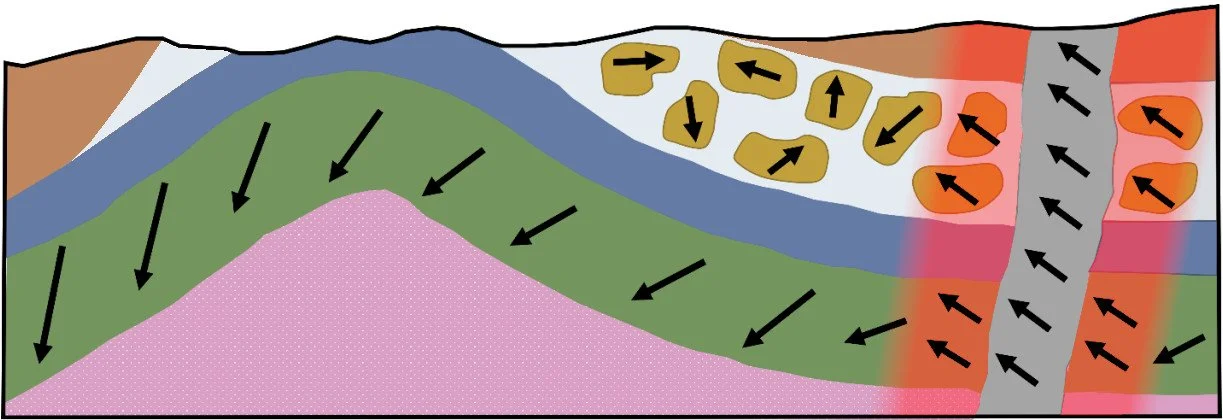
A crucial part of paleomagnetic studies is to establish that the magnetic signals being measured date back to the original events being studied, rather than to some intervening event, such as metamorphism or hydrothermal flows, that could erase or overprint the original magnetization. In the podcast, Brenner describes several tests that are performed to this end. The figure illustrates two of them: the fold test and a baked-contact test. In the fold test, the magnetic signal is original only if the field aligns when the effect of folding is removed (green layer). In the baked-contact test, the field is original if it deviates from the measured direction only within the cross-cutting intrusion (grey) or adjacent to the intrusion in the baked contact (red), reverting to the measured direction farther away from the intrusion (green).
Models Consistent With the Observed Plate Motion
Computer simulation of global episodic plate motion. This is one of a suite of models exploring variations of the assumed parameters. In this model, the parameters are 10^20 Pa-s reference viscosity, 40 MPa lithospheric yield strength, and 20 percent eruption efficiency. The model exhibits episodic behavior that arises naturally from the simulation dynamics. The episodic behavior occurs at rates similar to those observed by Brenner and his team and reproduces other features observable in their data. However, it also shares some characteristics with active-lid plate tectonics with less episodicity, especially later in the simulation.
Courtesy of Lourenço, D. L. et al. (2020) Geochemistry, Geophysics, Geosystems 21, e2019GC008756