
Ed Brook on Antarctica’s Oldest Ice
Listen to the podcast here or wherever you get your podcasts.
Podcast Illustrations
Allan Hills
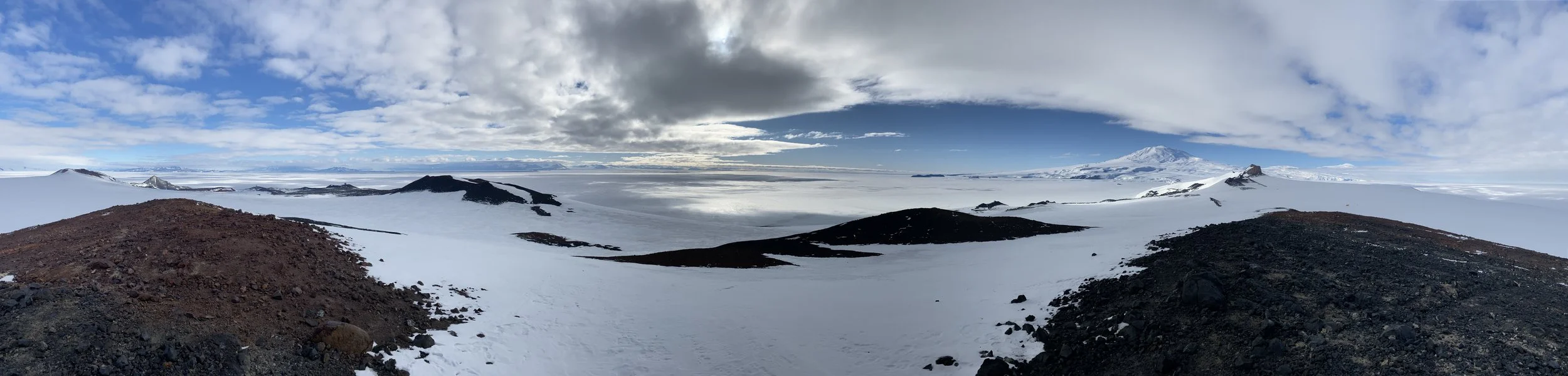
The Allan Hills, where ice flowing from the Antarctic interior runs up against the Transantarctic Mountains and nearly stalls. Strong winds strip away fresh snow and surface ice, so very old ice ends up close to the surface.
Photo: Austin Carter, COLDEX
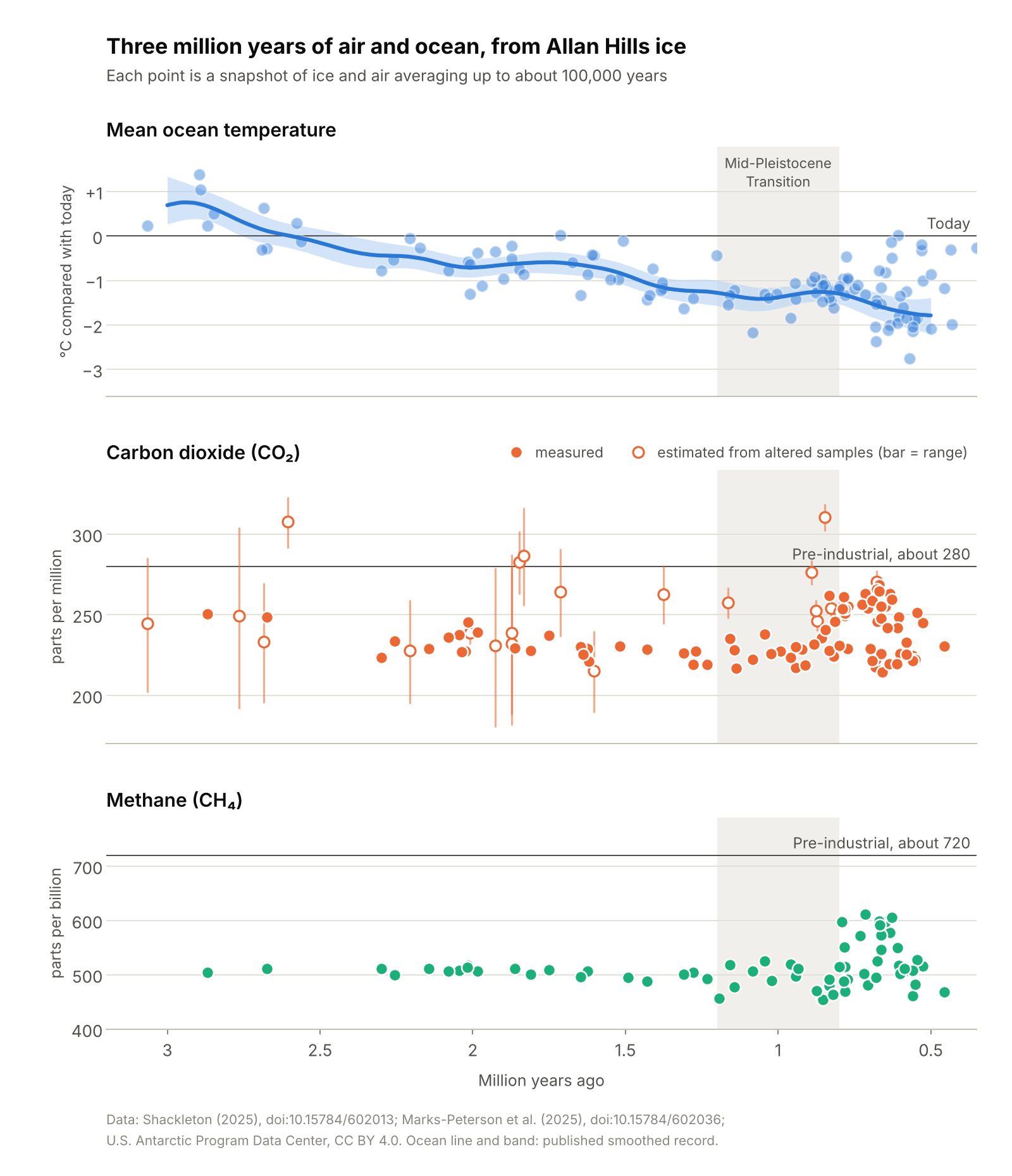
Three million years of climate from Allan Hills ice. Top: the average temperature of the entire ocean, read from xenon and krypton in the trapped air, fell by about 2.5°C, with a sharp drop around 2.7 million years ago. Middle and bottom: over the same span, carbon dioxide fell by only about 20 parts per million and methane barely changed. Open circles are estimates from samples in which microbes had added CO₂; bars show their range. Shading marks the Mid-Pleistocene Transition, when ice-age cycles lengthened from 41,000 to about 100,000 years.
Data: Shackleton, S. (2025), U.S. Antarctic Program Data Center, doi:10.15784/602013; Marks-Peterson, J., et al. (2025), U.S. Antarctic Program Data Center, doi:10.15784/602036 (CC BY 4.0). See Marks-Peterson, J., et al. (2026), Nature 651:647; Shackleton, S., et al. (2026), Nature 651:653.