
Sara Pruss on the First Reef Builders
Listen to the podcast here or wherever you get your podcasts.

In the podcast, Sara Pruss describes the first multicellular animals to build reefs. They were sponges called archaeocyaths. Pruss explains the evidence that the rise of the archaeocyaths fostered an increase in animal diversity. But they were relatively short-lived, and when they died out in the Middle Cambrian, the diversity declined. Over geological time, reef-building organisms appear and disappear again and again until the corals we have today appeared in the Middle Triassic, about 240 million years ago.
Pruss is currently trying to understand why reefs are such a persistent feature of the geological record, despite the environmental stresses imposed on them. She is a Professor of Geosciences at Smith College.
Podcast Illustrations
Images courtesy of Sara Pruss unless otherwise indicated.
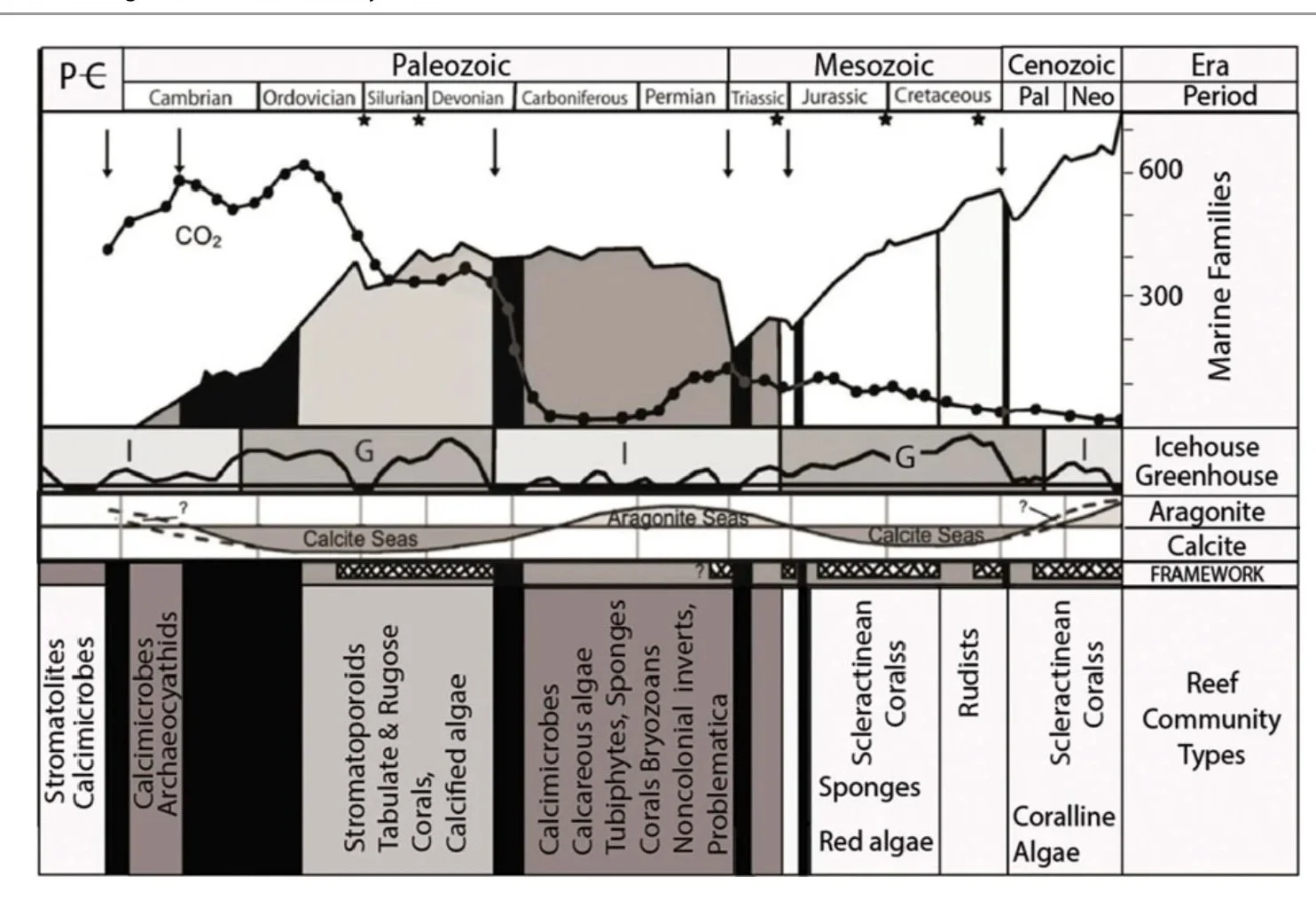
Timeline of reef-building organisms from the Precambrian (PC) at left to the Neogene (Neo, 20.4 to 2.4 million years ago) at right. Although microbes formed reef-like structures in the Neoproterozoic (PC, far left), reefs built by multicellular animals did not appear until the early Paleozoic, of which the earliest were the archaeocyaths, a type of sponge. From then until the present, reefs diversified, underwent extinctions many times, and then diversified again. Paleozoic reefs consisted of sponges, corals, foraminifera, algae, bryozoans, and brachiopods, among others. The major extinction event at the end of the Paleozoic (Permian-Triassic, at the center of the timeline) eliminated these forms as reef constituents, and new groups (e.g., the first scleractinian (stony) corals which dominate coral reefs today) appeared in the Triassic.
Lipps, J. H. & Stanley Jr, J. D. (2016), Reefs Through Time: An Evolutionary View in Coral Reefs at the Crossroads
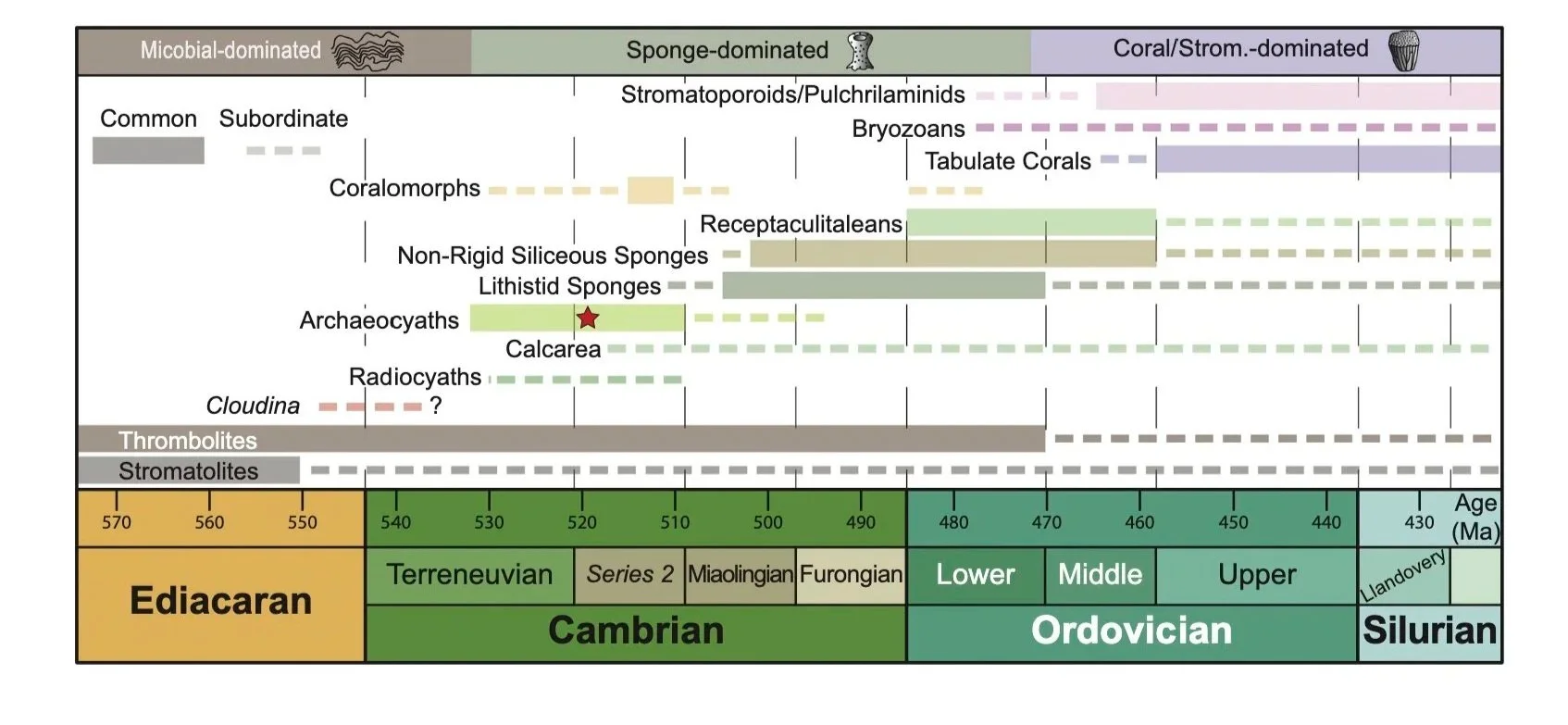
Primary reef builders during the Neoproterozoic (Ediacaran) and early Paleozoic (Cambrian, Ordovician, and Silurian). The Neoproterozoic is primarily dominated by microbial organisms including the stromatolites (see Geology Bites episode with Martin Van Kranendonk). The Cambrian is dominated by a variety of sponge organisms including the archaeocyaths. In the Ordovician and Silurian, coral and stromatoporoid species became the dominant reef builders. The red star denotes the approximate interval of the Mongolian reefs where some of the best-preserved archaeocyath reefs are found.
Cordie, D. R. et al. (2019), Palaeogeography, Palaeoclimatology, Palaeoecology 514, 206
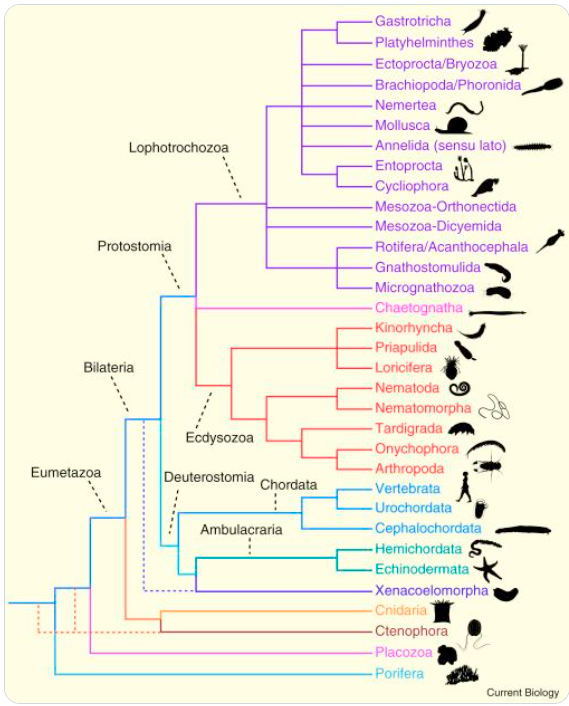
The archaeocyaths are a class of the phylum Porifera (Sponges), the line at the bottom of the tree shown here. As the figure shows, Sponges split diverged from all the other phyla shown very early in evolutionary history.
Telford, M.J. et al. (2015), Current Biology 25(19), 876
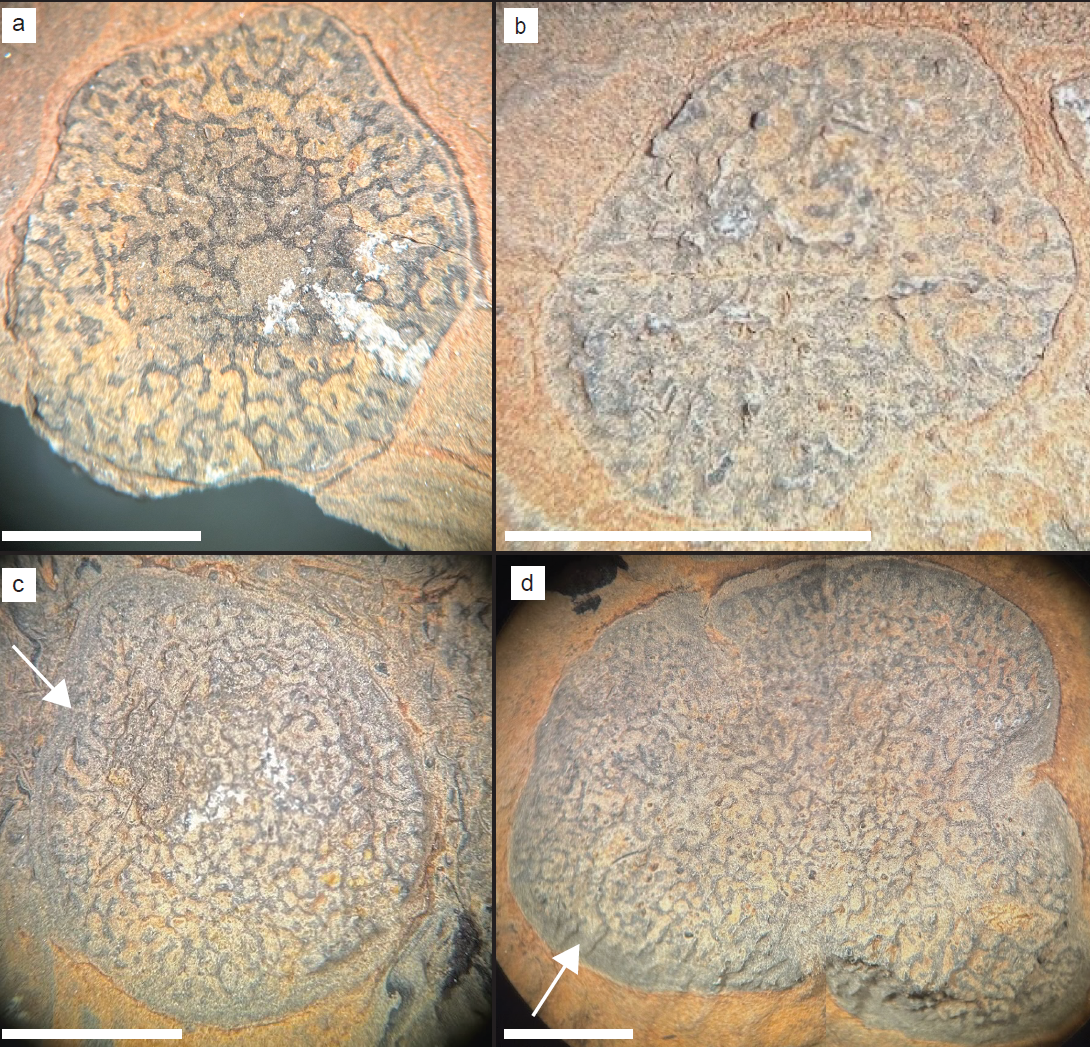
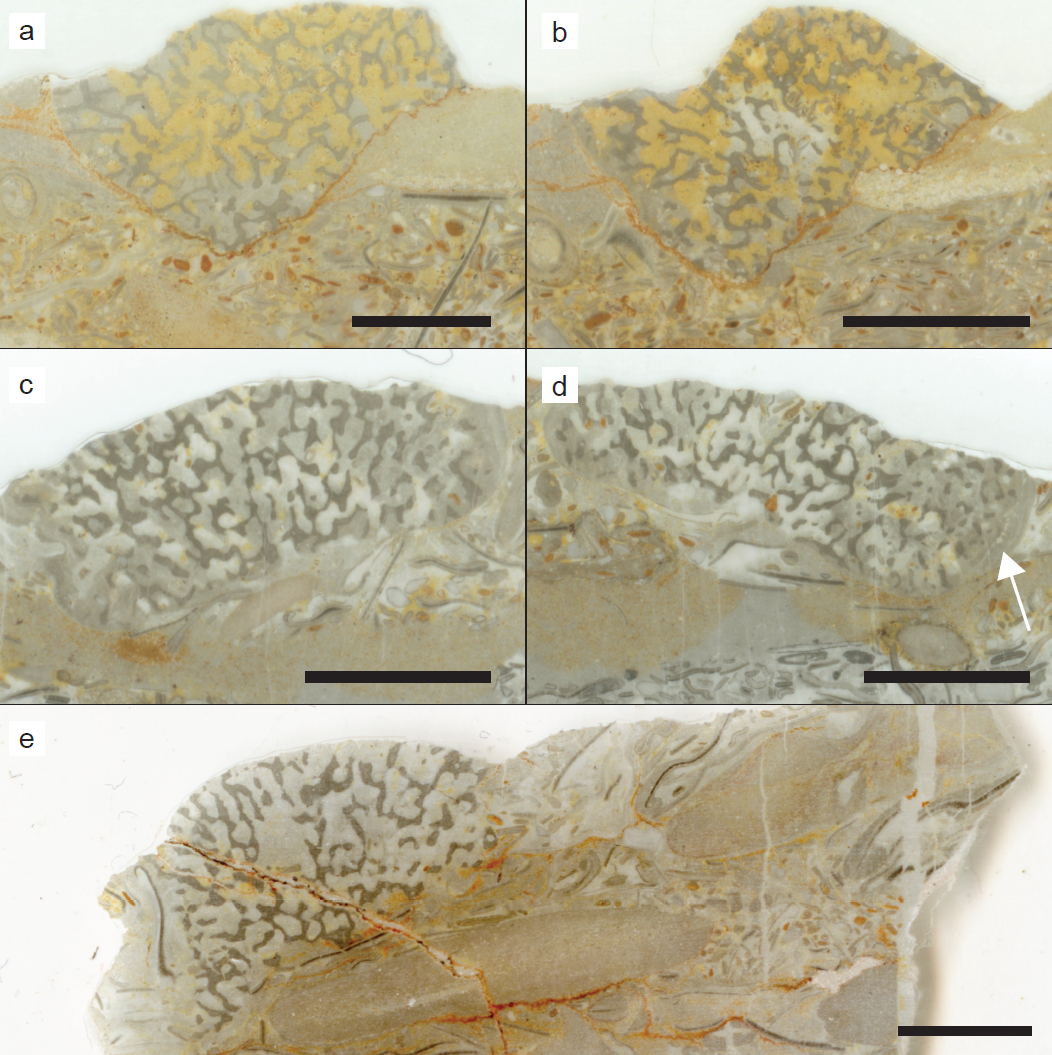
a, b: Archaeocyaths from the Carrara Formation and Mule Springs Formation in the western United states. These are the last known occurrences of archaeocyaths in the western United States. c: Archaecyaths with a microbial coating that was made into the thin sections shown above right in c and d. d: the largest archaeocyath from the Carrara formation. White arrows show microbial coatings forming around archaeocyaths. All scale bars are 5 mm.
Pruss, S.B. et al. (2024), Palaios 39(6): 210
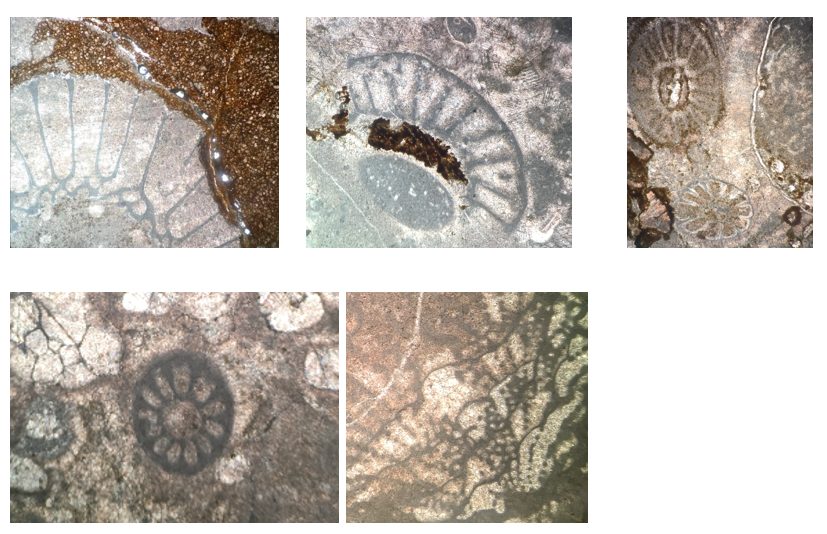
Archaeocyath thin sections from the lower Poleta Formation near Gold Point, Nevada. The archaeocyath cups are 1-2 cm in diameter.
Courtesy of M. Slaymaker
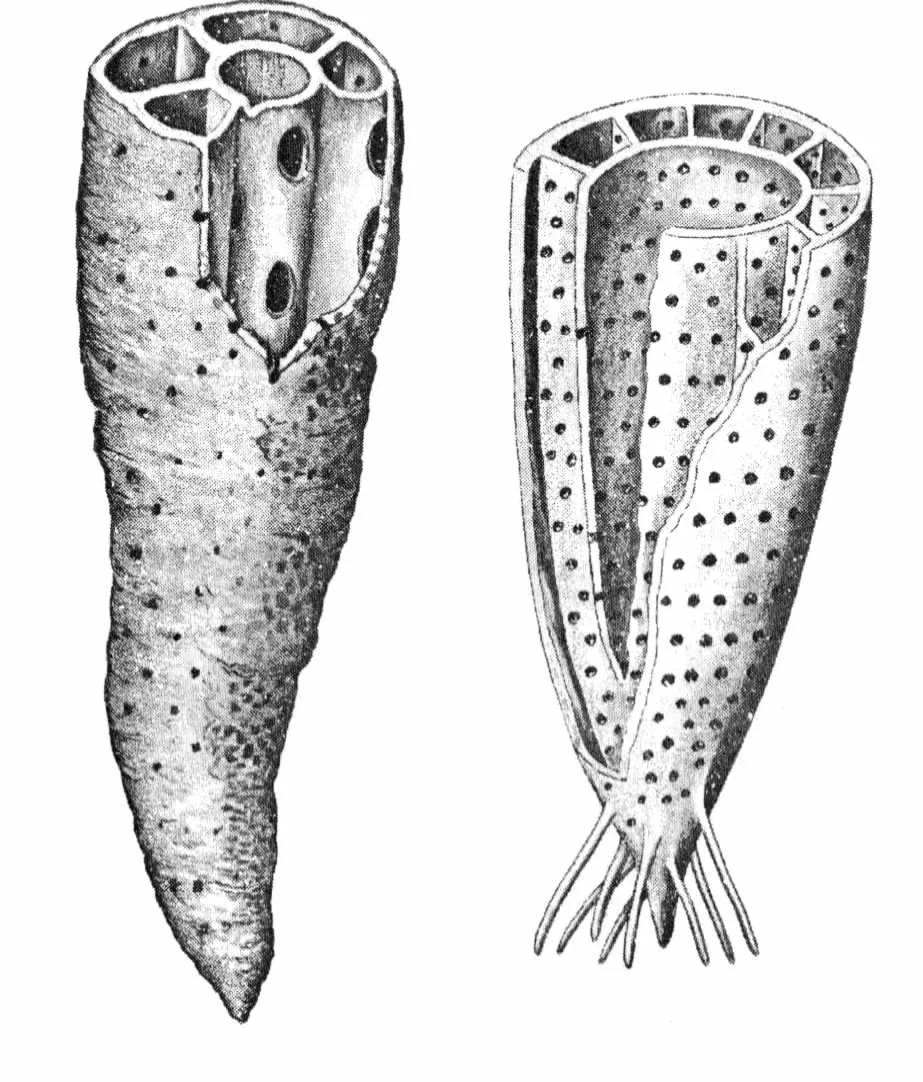
Sketch of form and structure of achaeocyaths. Archaeocyatha were sessile, filter-feeding, calcareous, sponge-like organisms, characterized by a conical, vase-shaped, or cylindrical skeleton. Their structure consisted of two porous, nested calcite cones (inner and outer walls) separated by a space called the intervallum, which contained vertical plates (septa, taeniae) or horizontal plates (tabulae). Root-like structures at the bottom (holdfast) secured them in place.
https://alchetron.com/Archaeocyatha
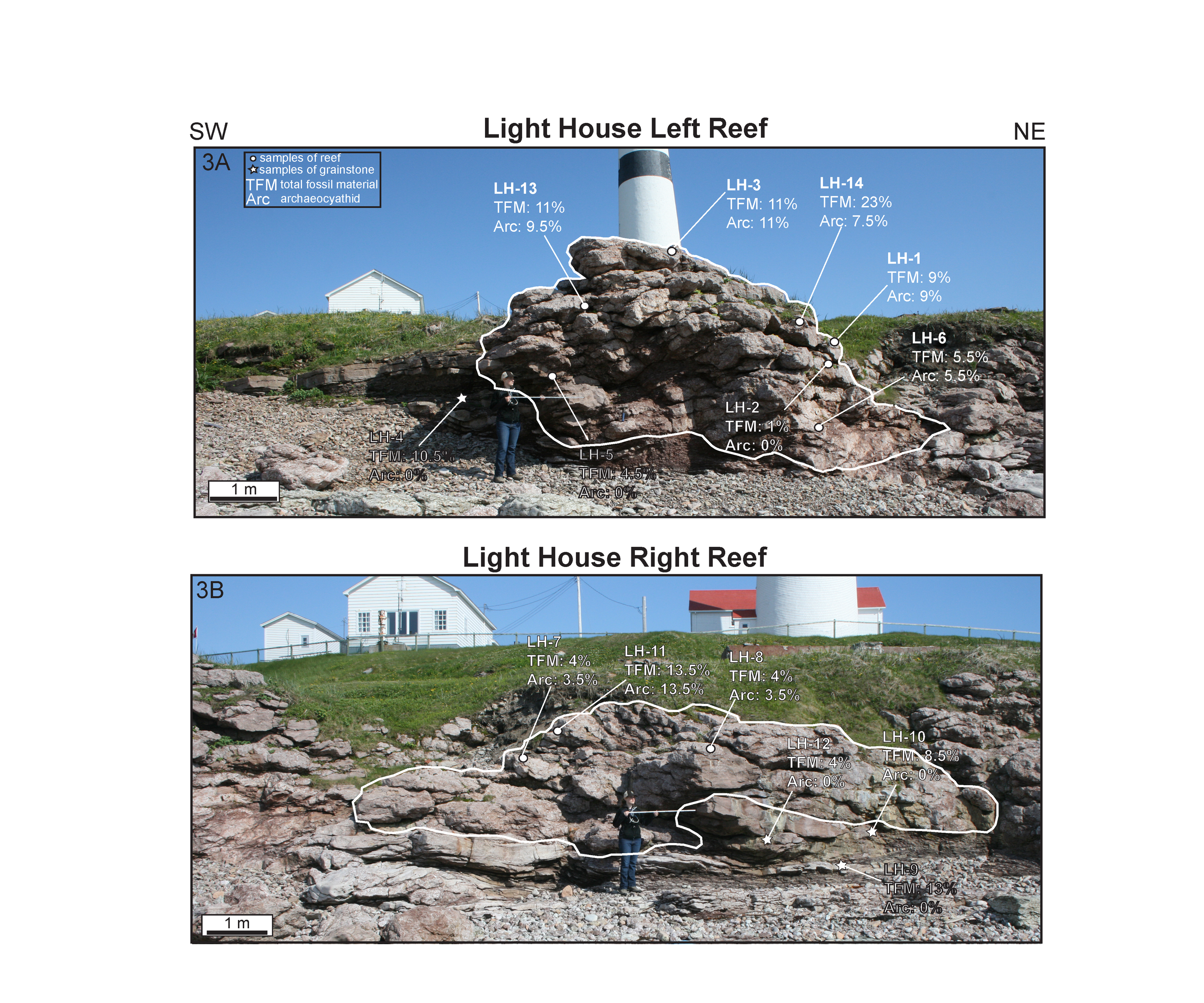
Archaeocyath patch reefs on the southern coast of Labrador near Forteau. These are exposed along the sea cliffs, and Pruss and her team sampled the reefs and surrounding beds to determine how much skeletal mass was present within and around the reefs. TFM is the percentage of total fossil material counted in thin section, and archaeo represents the amount of skeletal material that is comprised of archaeocyaths. Notably, some beds outside the reef mounds themselves have high skeletal abundance without any archaeocyaths, for example F-LH-9-9, TFM: 9.5%, 0% Archaeo. Here, many of the animals living on and around the reefs would have been trilobites and echinoderms.
Pruss, S.. B., et al. (2012), Lethaia 45(3), 401
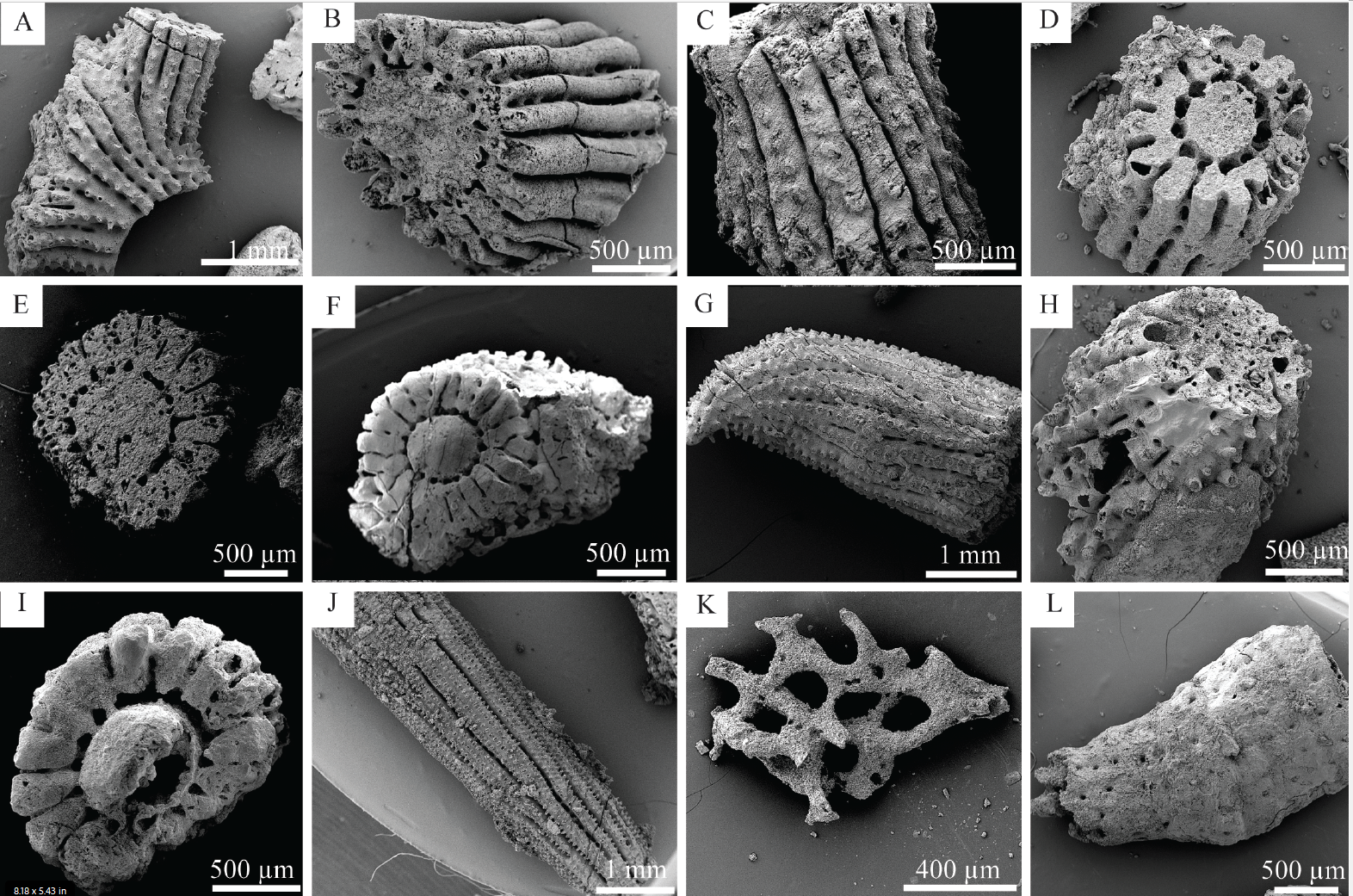
Phosphatized internal molds of archaeocyaths from the upper Salaagol Formation in southwestern Mongolia.
Pruss, S. B. et al. (2019), Palaeogeography, Palaeoclimatology, Palaeoecology 513, 166
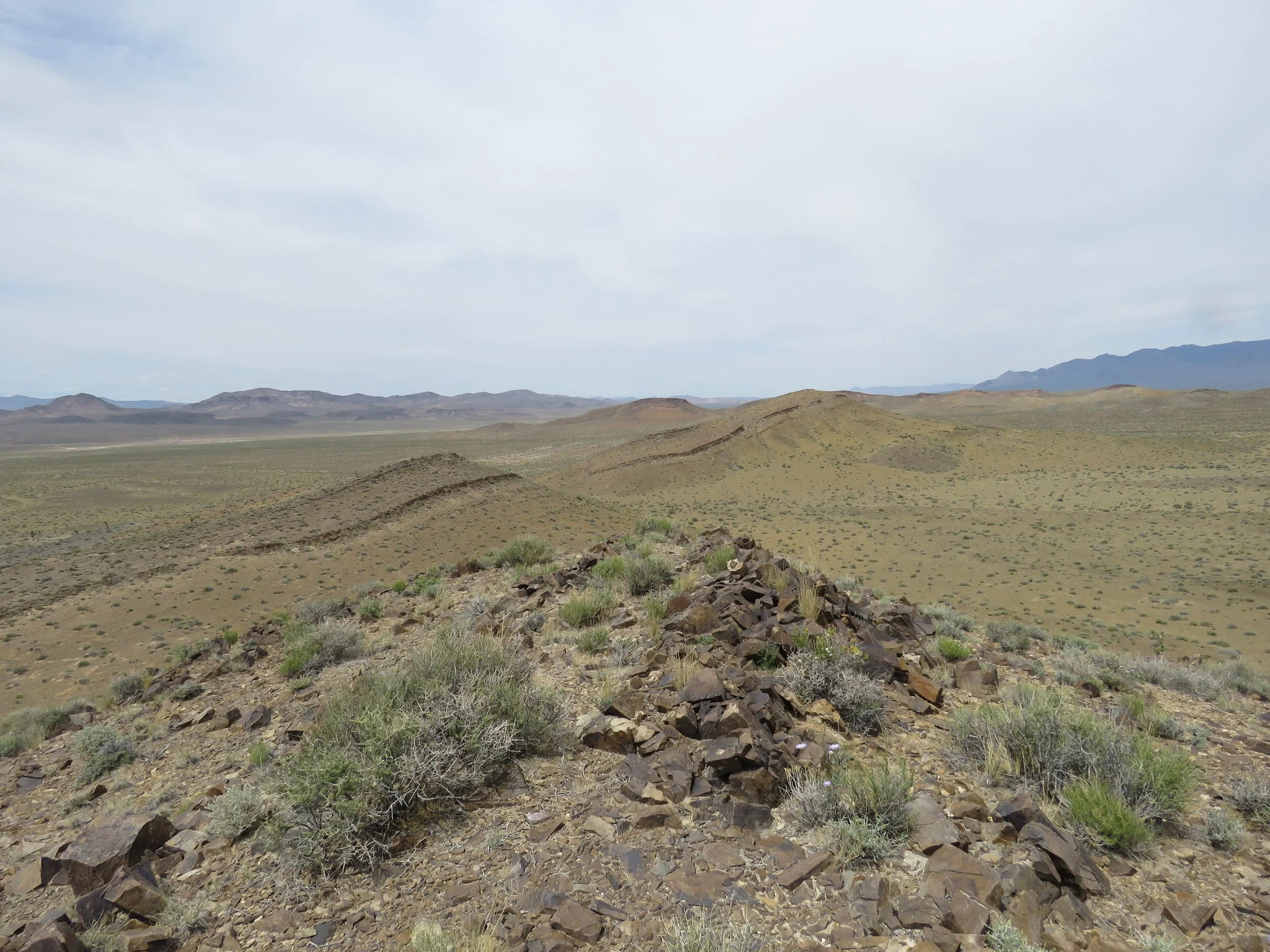
The upper Harkless Formation and the archaeocyath reefs in southern Nevada. In the foreground is sandstone that overlies the archaeocyath reef beds. In the background, the ridges on the hills represent the archaeocyath reef horizon and overlying siliciclastic beds.
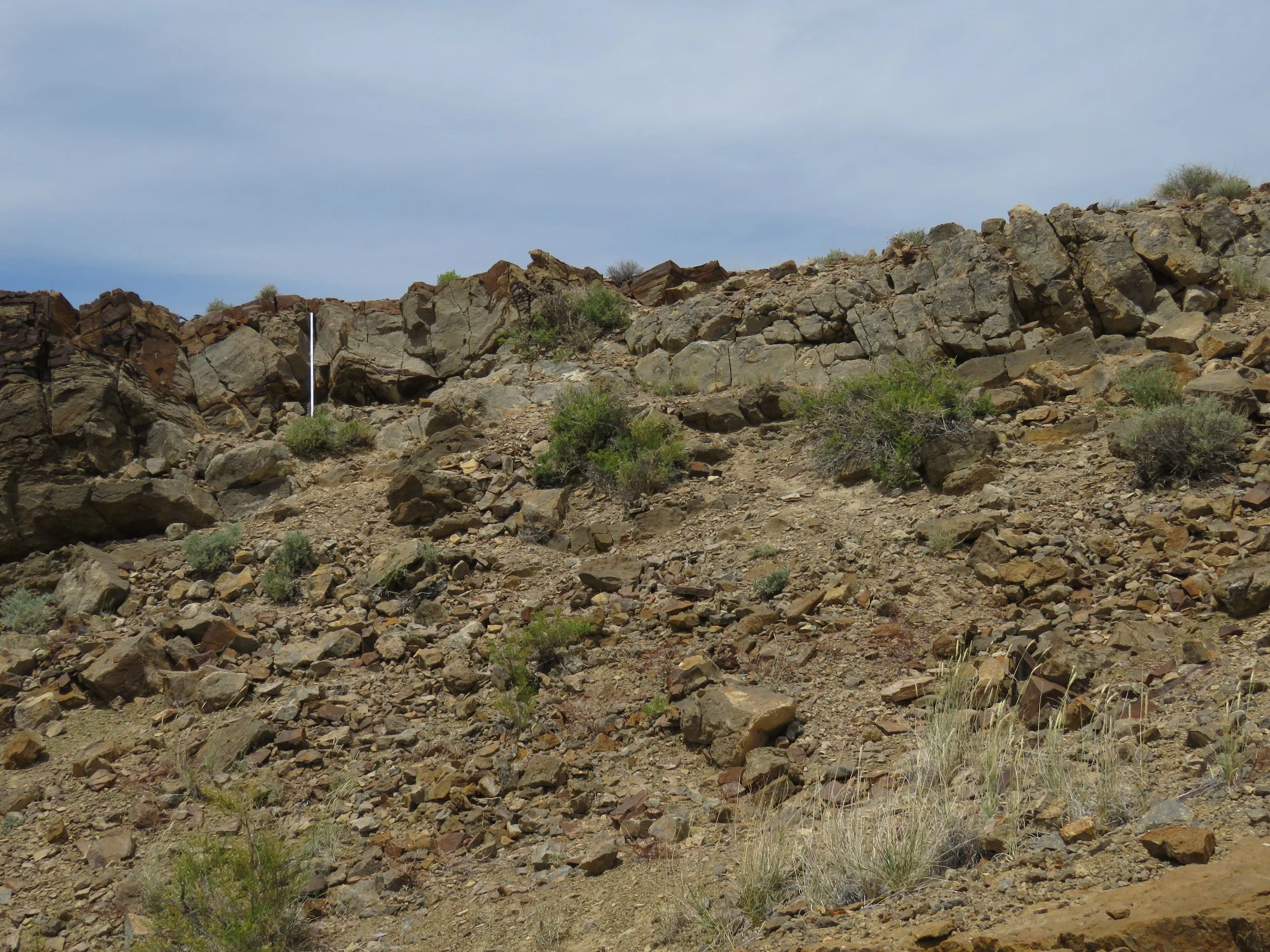
The gray beds in the center of the outcrop to the right of the measuring stick (2 m) are the archaeocyath reef mounds of the upper Harkless Formation.
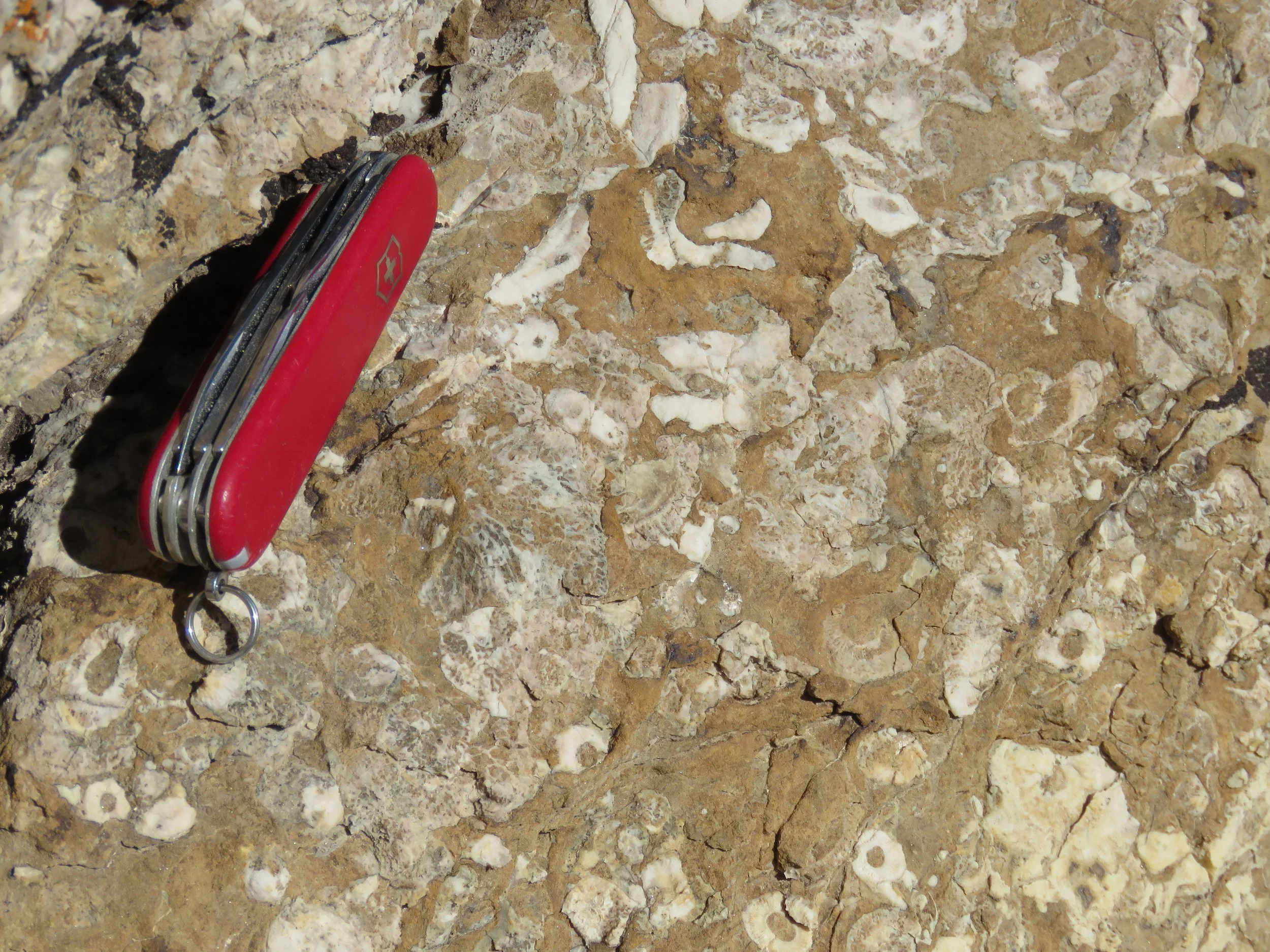
In this closeup of an upper Harkless Formation archaeocyath reef, the cup architecture of the archaeocyath skeleton can be seen, mostly as cross-sections of cones.
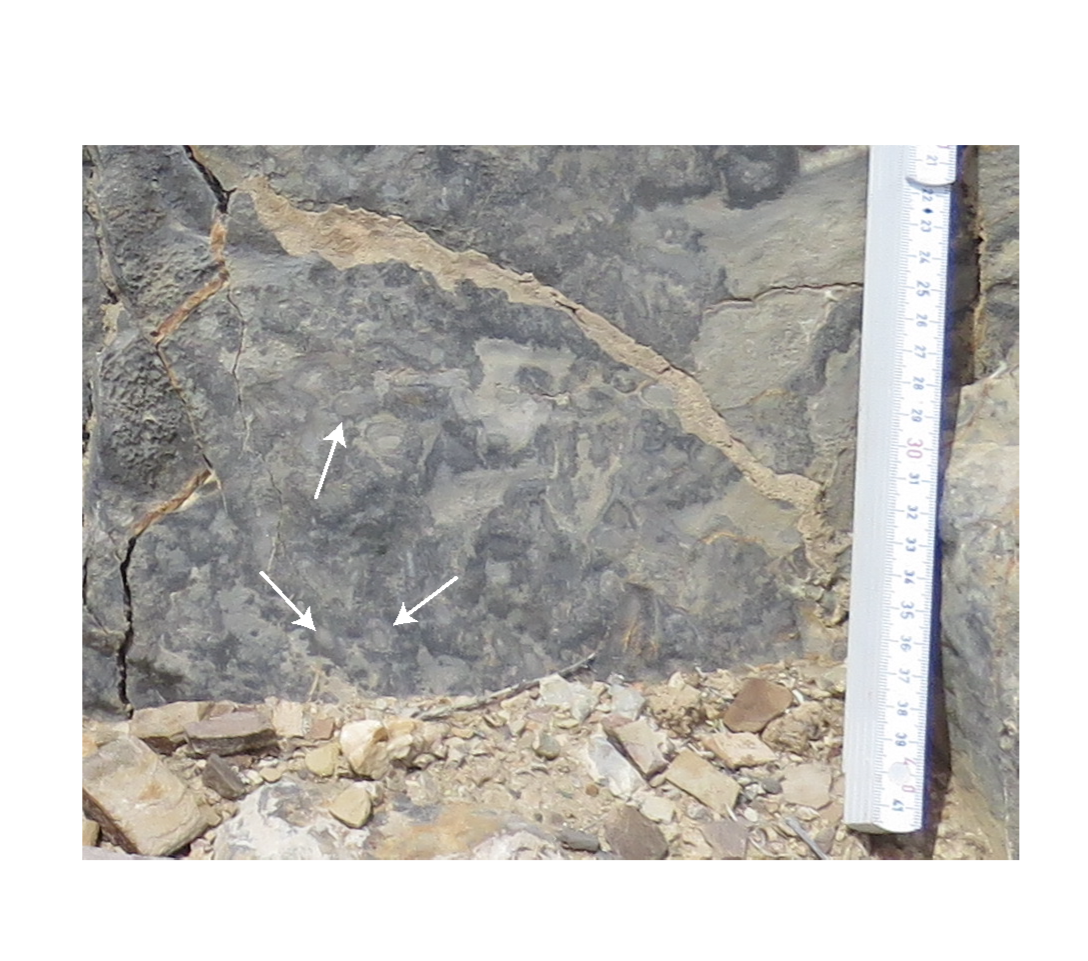
In this portion of the reef, occasional circular cross-sections of the archaeocyath cones can be seen (white arrows), as well as the dark gray microbial fabrics surrounding them. This shows the close relationship between the archaeocyaths and the microbial fabrics that lived with them.
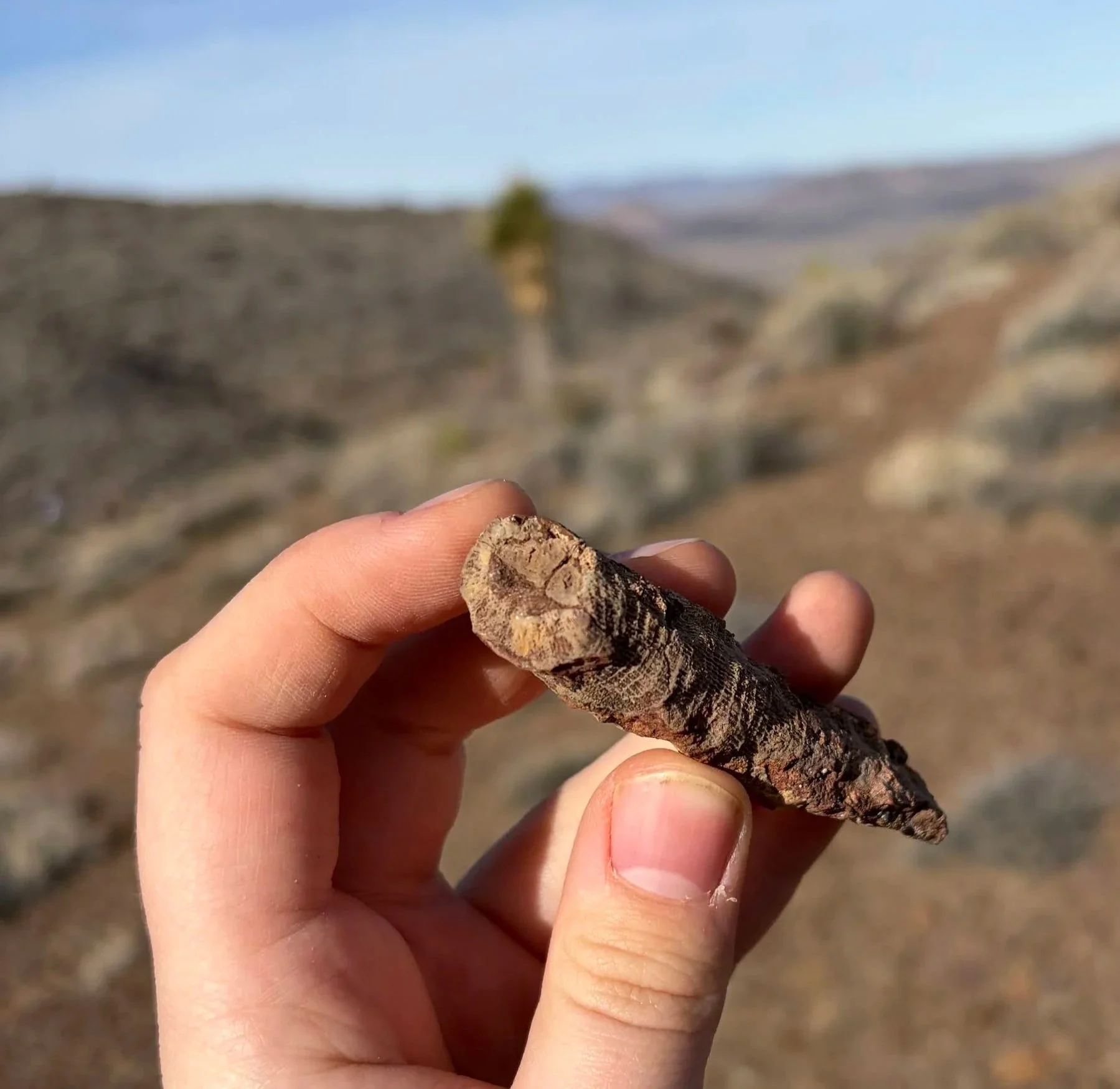
Archaeocyath individual from the lower Harkless reef near Gold Point, Nevada, showing the cone shape, the cross-section revealing the intervallum and septae, and central cavity. (See the labeled sketch above.)
Rheva Wolf and Quinnlan Steele
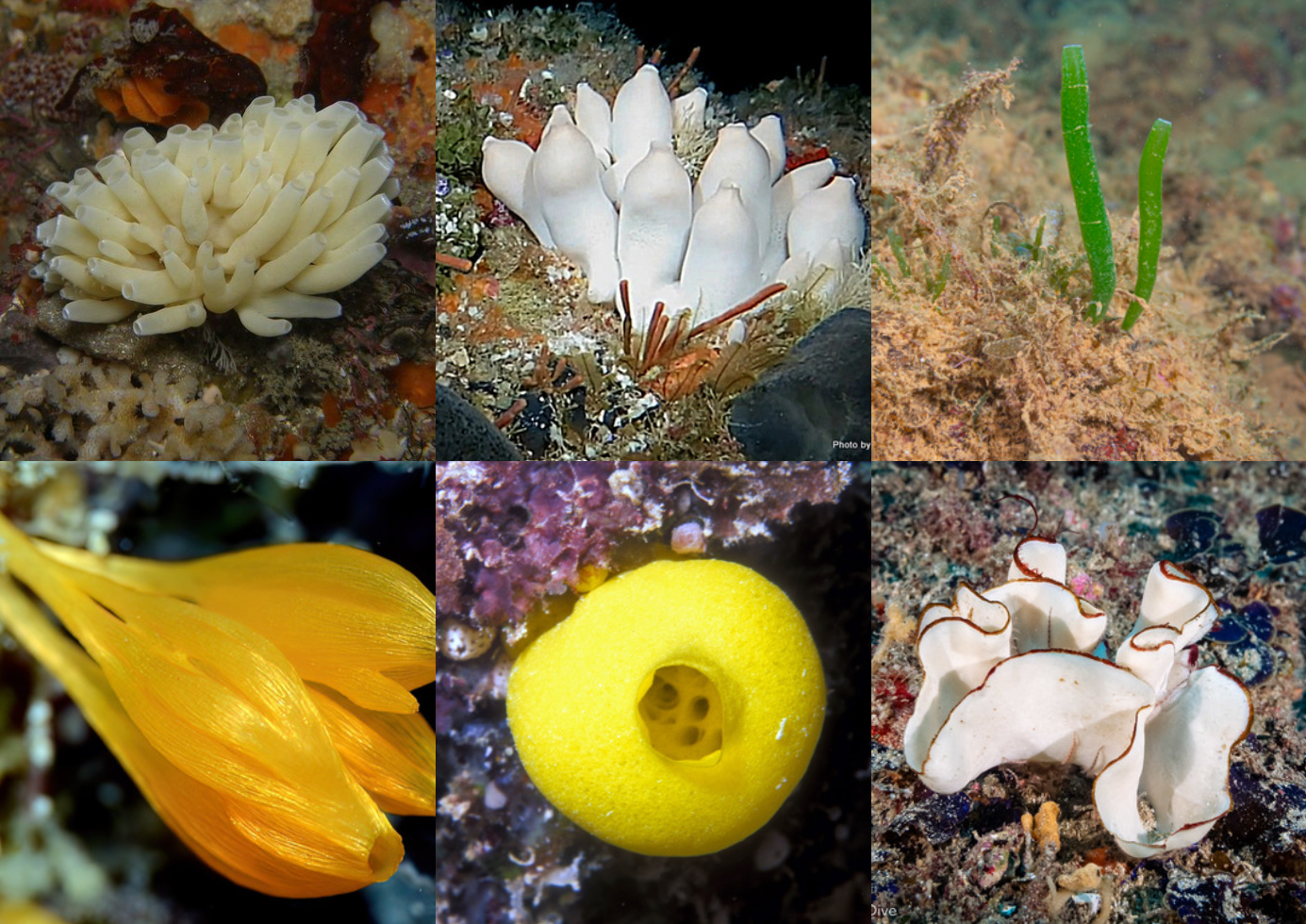
Modern calcareous sponges provide the closest analog to the archaeocyaths.
https://www.inaturalist.org/taxa/60583-Calcarea